


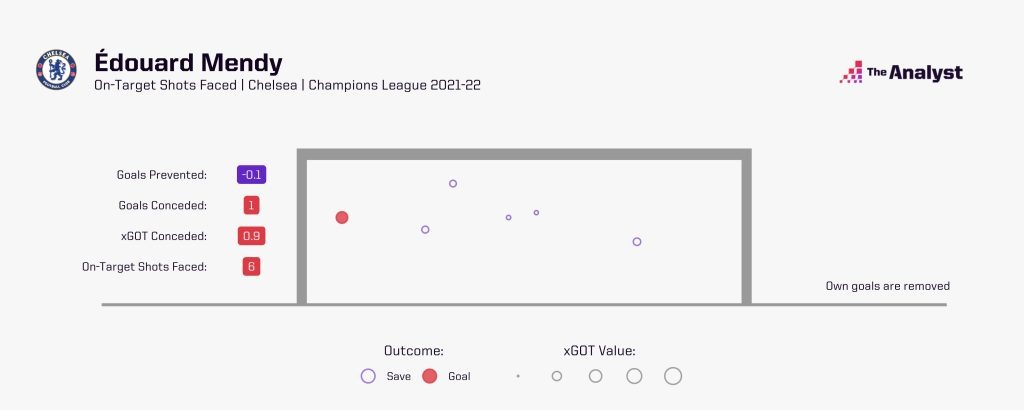
Édouard Mendy has kept 14 clean sheets in his 18 UEFA Champions League appearances so far, with only Edwin Van der Sar keeping his first 14 clean sheets in as few games in the competition. The Dutchman also went on to keep his 15th in his 19th appearance in the UCL.
Of goalkeepers to have made at least 10 appearances in the Champions League, Mendy’s clean sheet rate of 78% is by far the best, but with it being so early in his UCL career it’s hard to fairly compare him with Van der Sar, who has the next best ratio of 51%. At this moment in time, Van der Sar has played 80 games more than the French goalkeeper (98 apps, 50 clean sheets).
Chelsea’s defence have helped boost their goalkeeper’s record since his arrival, allowing very few shots to make their way through to Mendy. Since the start of last season, Mendy has faced a shot on target every 41 minutes on average – only Manchester City’s Ederson (45 mins) has faced a shot on target less frequently over this period.
Across 2021-22 so far, Chelsea have allowed their opponents only 14 shots on target in seven games – a competition-low this season, while these have had a season-low expected goals on target total of 4.6. Over half of these shots on target (8) and over 80% of the xGOT tally (3.7) came in the single game that Mendy didn’t appear in – a 3-3 away draw with Zenit St Petersburg in their final group stage game, which Kepa Arrizabalaga played.
There’s little doubt that Mendy is a top-class goalkeeper, but his Champions League career so far has been made a lot easier thanks to his protective Chelsea defence.
The Nations League
Following the results in the first leg matches in the round of 16 this season, it seems likely that Liverpool, Manchester City and Chelsea can expect to be in the quarter finals in 2021-22. Manchester United host Atletico Madrid after a 1-1 first leg draw in Spain, so we could see English clubs make up half of the quarter-final line-up.
There’s only been three previous occasions of a nation having four different teams in the UEFA Champions League quarter finals within a season – all of those have involved in English clubs.
The last time this occurred was in 2018-19, where Manchester City and Tottenham met in the quarter-finals and served up an all-time competition classic with a 4-4 draw and Spurs going through on away goals.
2008-09 saw Arsenal, Manchester United, Chelsea and Liverpool make it through to the quarters, with the latter two facing each other and playing out another classic tie – the Blues’ advancing 7-5 on aggregate.
The season before this in 2007-08 was the first with four teams from one nation, with the same four clubs as 2008-09. This time it saw Arsenal and Liverpool meet, with Liverpool going through 5-3 after two legs.
None of the three Spanish clubs in the last 16 this season lead their tie after the first leg. Should none of them make it through, it’ll be the first UCL season since 2004-05 to not contain a single Spanish side in the quarter-final. Meanwhile, we could see the second successive season without an Italian club in the last eight.
Of course, it’s common to see clubs from the big five European leagues in the final eight of the Champions League since the round first came in to play in 1994-95. Spain (52), England (47), Germany (33), Italy (30) and France (20) make up 84% of the representatives of quarter-final teams since then, with Portugal (11) and the Netherlands (7) adding a further 18 to that tally.
It’s not frequent that we see any quarter-finalists from nations outside of those seven in the Champions League, but RB Salzburg have a chance to replicate the feats of the teams listed below:
1994-95: Hajduk Split (Croatia)
1994-95: IFK Göteborg (Sweden)
1995-96: Legia Warsaw (Poland)
1995-96: Panathinaikos (Greece)
1995-96: Spartak Moscow (Russia)
1996-97: Rosenborg (Norway)
1997-98: Dynamo Kyiv (Ukraine)
1998-99: Dynamo Kyiv (Ukraine)
1998-99: Olympiakos (Greece)
2000-01: Galatasaray (Turkey)
2001-02: Panathinaikos (Greece)
2007-08: Fenerbahçe (Turkey)
2009-10: CSKA Moscow (Russia)
2010-11: Shakhtar Donetsk (Ukraine)
2011-12: APOEL Nicosia (Cyprus)
2012-13: Galatasaray (Turkey)
Bayern and Liverpool Duos Continue to Chase Down History
Fact: Cristiano Ronaldo is the greatest Champions League goalscorer of all time. With 140 total goals in Europe’s premier competition, he is currently 15 clear of rival Lionel Messi.
Also a fact: The Cristiano Ronaldo-Karim Benzema axis is the greatest Champions League goalscoring duo of all time.
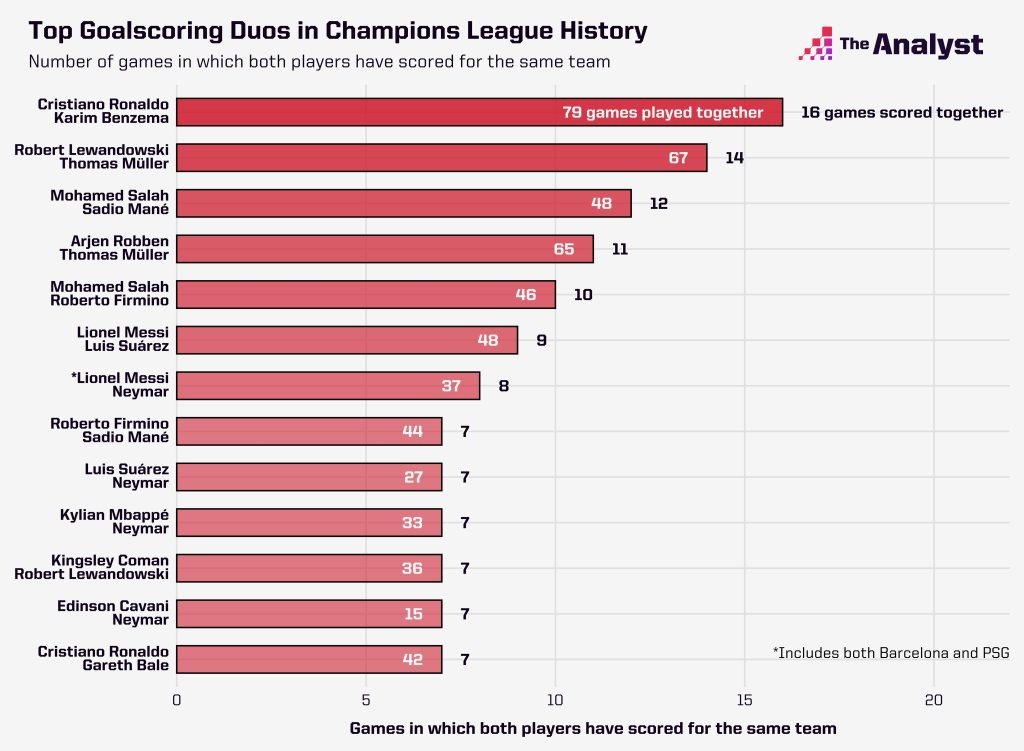
The above chart looks at the total number of games in which both players have scored for the same team. Ronaldo and Benzema have scored in the same game for Real Madrid on 16 different occasions, the highest total number of matches of any two players in Champions League history.
It’s hardly surprising really, with the duo key contributors to Real’s dominance in Europe over the past decade. Madrid have won four of the past eight competitions, including a run of three in a row from 2015-16 to 2017-18. In each of those consecutive tournament wins, Ronaldo rightly won the plaudits for his astonishing goal tallies, but Benzema finished as Real’s second-highest scorer on each occasion. Now with Ronaldo out of the spotlight, Benzema is arguably in the best form of his career. Then again, maybe he always was.
With Ronaldo’s return to Manchester United, the pair won’t have a chance to improve their tally.
That leaves the door open for Robert Lewandowski and Thomas Müller to close the gap, with the pair both scoring together on 14 occasions in Champions League history. Müller is well known for his creative qualities, particularly when providing for Lewandowski. Since assist records began in 2004-05 in the Bundesliga, Müller has assisted more than double the number of goals for Lewandowski than any other player has for a single team-mate in the German top-flight. But he is also an unheralded marksman. With 50 Champions League goals, he is joint-eighth on the all-time records list tied with Thierry Henry. With Bayern heavy favourites to progress into the quarter-finals this week, the pair can continue to break more records together.
This chart is about duos, but it also serves to highlight the importance of a trio at Liverpool: Mohamed Salah, Roberto Firmino and Sadio Mane. The group appear on this list three separate times in different combinations and, looking at games played, have got there very quickly. Liverpool’s home group game to Sevilla in September 2017 – a game in which all three made their Champions League debut for the club – saw Salah and Mané score and Firmino miss a penalty. In forebode what was to come.
That 2017-18 ended in final heartbreak for Liverpool, but each of Salah, Mane and Firmino scored 10 goals in the campaign, the first time a team has ever had three players from the same team hit double figures. The English Iniesta – aka James Milner – also topped the assist charts with nine.
Such has been their contribution to the side that since that game against Sevilla, Salah, Firmino and Mane have scored 65% of all Liverpool’s UCL goals.
‘Away Goals’ Have Gone, But Away Goals Remain
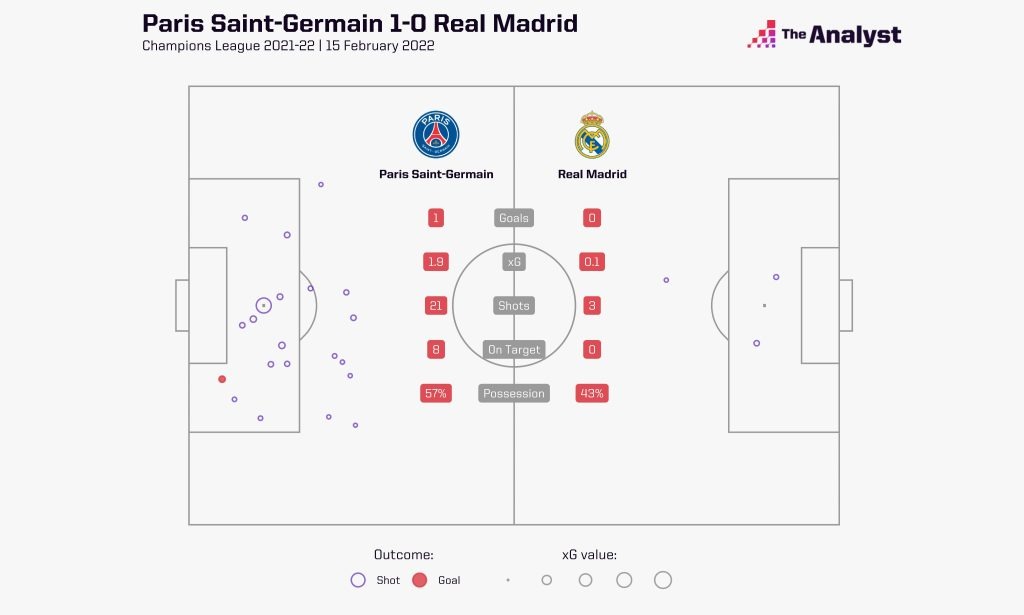
This round of Champions League knockout matches are the first since UEFA abolished the away goals rule in knockout football. After Paris Saint-Germain’s 1-0 victory over Real Madrid, many onlookers feared they were seeing an unintended effect of that rule change. In Paris, Carlo Ancelotti’s side were content to sit back and absorb pressure.
The argument was that with no incentive to strive for the valuable away goal, Real could cede possession and play without the ball. Their 43% possession figure was the lowest they’ve registered in a Champions League game since the second leg in the semi-final against Bayern in 2018.
And as the shot map below shows, they failed to land a shot on target for just the second time in a UCL game since 2003-04 (when Opta shot data is available), and their 0.14 xG total is their second-lowest in recorded Champions League history.
The decision to scrap the away goals rule came as UEFA bosses felt it now ran against its original purpose. Regarding the decision, UEFA president Aleksandr Ceferin said:
“The impact of the rule now runs counter to its original purpose as, in fact, it now dissuades home teams, especially in first legs, from attacking, because they fear conceding a goal that would give their opponents a crucial advantage. Knowing that away goals don’t factor as heavily in a series as they used to, teams playing at home can theoretically afford to take more risks and that could provide an opportunity for more expressive attacking displays.”
Results elsewhere in the last 16 run slightly contrary to the PSG-Real argument. Yes, it’s a small sample and yes, the results are skewed by strong teams (Manchester City and Liverpool) beating up on away teams, but so far 12 of the 20 goals in the last 16 have come from the away side (60%), the highest proportion in any competition since the last 16 began in 2002-03.
But the benefits of the rule change may come in the second legs. For teams hosting the second leg, conceding a goal on home soil is not as damaging as it once was, and less fatal to the hopes of a comeback in the second game by the side trailing on aggregate.
The second leg of Real against PSG is a good example. Madrid need to score at home, but even if PSG score an away goal, the tie is still more balanced. Under the old rule, a PSG away goal would force Madrid to score at least three to advance, but now they’d only need two to stay in the tie. Likewise, Salzburg, Villarreal and Benfica – all arguably underdogs to progress when the draw was made – have a better chance of progressing.
Might we see closer ties as a result? Time will tell.
Enjoy this? Subscribe to our newsletter to receive exclusive content.
from WordPress https://ift.tt/ZMjhXKf
via IFTTT


No comments:
Post a Comment